
A vision provides direction. To guide the work, it also needs to help a team choose what to do now, who will be accountable, and what will wait.
A leadership team can agree on an ambition and lose focus as soon as resources need to be allocated. Sales wants to accelerate. Operations needs to absorb demand. Managers have positions to fill. A technology project promises to solve part of the problem.
Each of these concerns deserves attention. A leader’s job is to connect them, understand their dependencies, and decide the order in which the organization can move forward.
A Reference I Have Revisited for Years
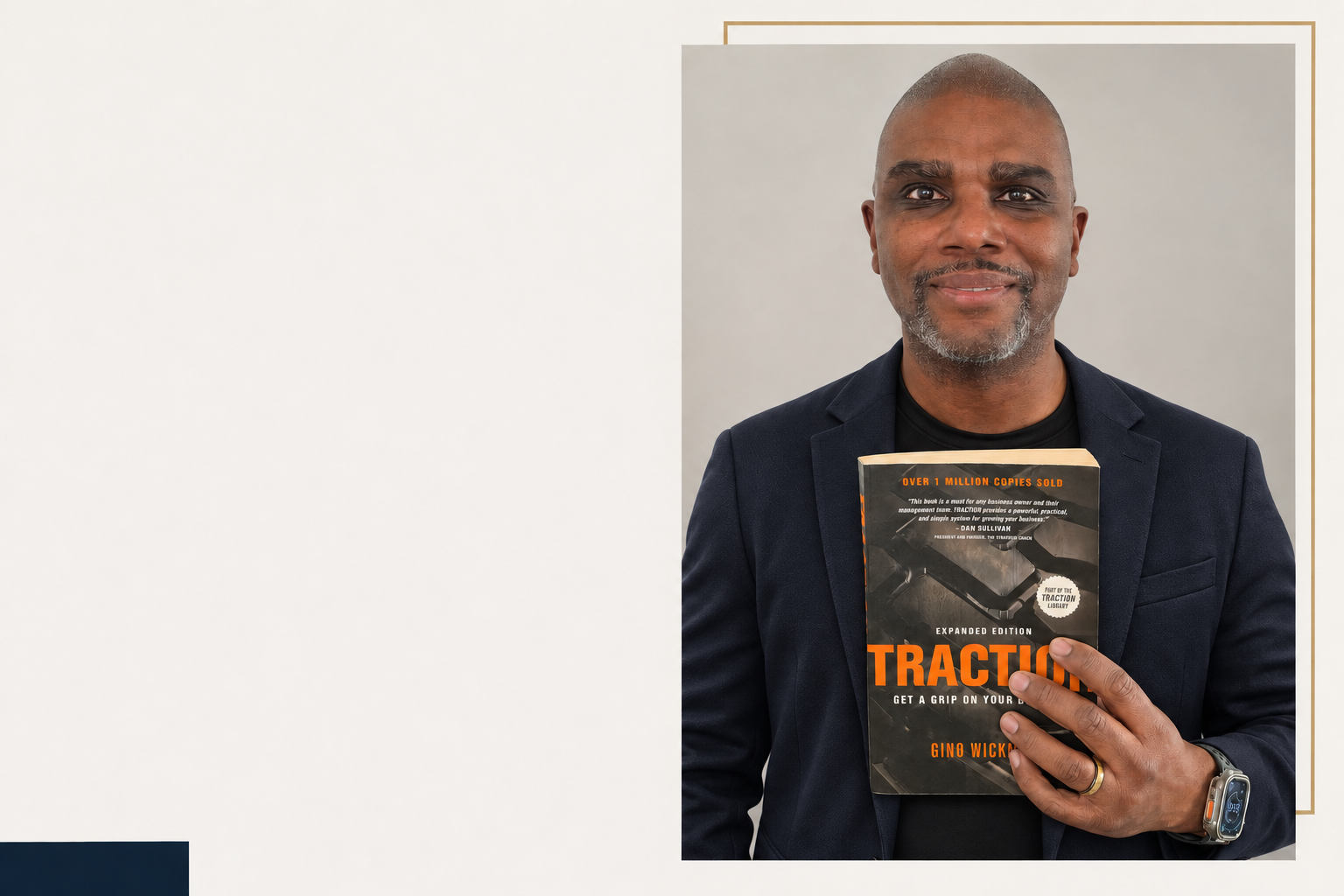
Traction, by Gino Wickman, has been a reference for me for several years. I have listened to it around fifty times on Audible and read it more than ten times. I also keep a Kindle edition to find specific passages or share a reference on screen.
Returning to it is part of how I learn. I revisit the book at different times, bringing questions that arise in my work. I alternate between listening and reading, and sometimes I read while listening.
This is the spirit of spaced repetition I seek: returning to ideas over time to explore them more deeply and keep them present in my practice. Different formats also let me consult a reference according to what I need at that moment.
Over the years, Traction has become a touchstone in how I think about vision, accountability, and execution. These are the disciplines I return to most often.
What I Take from Traction
Traction introduces EOS, the Entrepreneurial Operating System, a management approach that offers tools to clarify a company’s vision, responsibilities, and priorities.
What interests me is the alignment it seeks between intentions and day-to-day operations. A priority becomes much more useful when the people involved understand why it matters, what it needs to deliver, and which decisions it requires.
Three disciplines stand out for me: choosing a limited number of priorities, making accountability explicit, and maintaining a regular rhythm for addressing obstacles.
Choosing Means Making Room
In EOS, Rocks are the three to seven most important priorities to accomplish over 90 days. This framework connects longer-term ambitions to the work of the coming quarter.
For me, the decisive conversation happens when it is time to make room for those priorities. Which project slows down? Which request will wait? What capacity needs to be freed up? A short list can still be unrealistic if nobody has considered the ongoing workload.
A strategic priority therefore deserves a discussion about the resources and trade-offs it entails. Managers’ time, teams’ attention, and delivery capacity are limited. Leadership needs to account for those limits when making choices.
Define What “Done” Will Mean
“Improve the customer experience” expresses an intention. The team then needs to specify the change it expects.
Consider a hypothetical example: a company wants to improve how it welcomes new clients. A quarterly priority could be to define an onboarding journey, test it with three new clients, and assign a named person to oversee it.
This wording makes it possible to discuss scope, steps, and success criteria. It also helps distinguish delivering the journey from its effect on the client, which will need to be observed.
I place a lot of importance on this distinction. Completing a project and achieving the intended improvement are two things a leadership team needs to track.
Give the Accountable Person the Means to Move Forward
A priority can span several functions. In the onboarding example, sales, operations, and billing may need to adjust their practices together.
The accountable person needs to coordinate that work, obtain the necessary decisions, and raise obstacles. This means clarifying what they can decide, what requires approval, and what support other managers commit to providing.
This is an important contribution I see in the role of a VP of Operations or COO: making the company’s commitments compatible with one another and with its actual capacity. It requires understanding each function’s constraints and resolving trade-offs at the right level.
Return to Commitments Regularly
EOS distinguishes quarterly priorities from the metrics tracked each week. Its management cadence gives the team a regular space to review progress and resolve issues.
My takeaway: follow-up should help people make decisions. When a priority goes off track, the team needs to understand what is blocking it, determine the necessary action, and agree on who will take responsibility.
That conversation also requires recognizing early enough that an assumption was wrong or that a resource is missing. The quality of follow-up depends as much on the team’s candour as on the structure of the meeting.
Five Questions for Your Next Leadership Meeting
- How exactly does this priority connect to our strategic direction?
- What will allow us to say it is complete?
- Who is accountable, and which decisions can that person make?
- What do we need to give up or postpone to make room for it?
- When will we revisit obstacles and make the necessary decisions?
These questions can help even if your organization does not use EOS. They let you check whether the team shares a clear enough understanding to act.
Who I Recommend This Book To
I recommend Traction to leaders and managers who want to develop a common language for vision, accountability, and execution. It can also inform the thinking of a CEO who wants to clarify the role of their leadership team or future COO.
The question I would keep after reading it is simple: what does our vision actually help us decide this week?
The answer should be visible in our priorities, in how we use our resources, and in the commitments we are prepared to keep.
Further Resources
Traction: Get a Grip on Your Business, Gino Wickman. The EOS concepts mentioned are attributed to their source; the interpretations and questions offered express the author’s perspective.
- Take the EOS Organizational Checkup: a free self-assessment of your organization’s six key components. I suggest that leadership team members complete it individually, then compare their perceptions to identify priorities for discussion.
- EOS Worldwide: Rocks and their connection to other EOS tools
- EOS Worldwide: glossary of concepts
- David Casseus’s profile and approach